Humidity, HDB Living Rooms, and Your Solid Wood Sofa: A Singapore Owner’s Guide
Walk into any Tampines, Bedok, or Punggol flat during the morning rush and you will feel it on your skin before you see it on your furniture: heavy, warm, wet air. Singapore sits roughly one degree north of the equator, and our average relative humidity runs between 70% and 85% for most of the year, spiking above 90% on rainy afternoons and during the December monsoon surge. For an hdb livingroom filled with a solid wood sofa, a wooden dining table, a bed frame, and a wardrobe, that air is a quiet, constant pressure. It pushes and pulls moisture out of every timber joint, every drawer rail, every veneer edge, every solid wood leg. Over twelve to twenty-four months, that pressure shows up as hairline cracks on tabletop leaves, sticky drawers, sluggish wardrobe doors, and a faint musty smell in the corner where the sofa meets the wall.
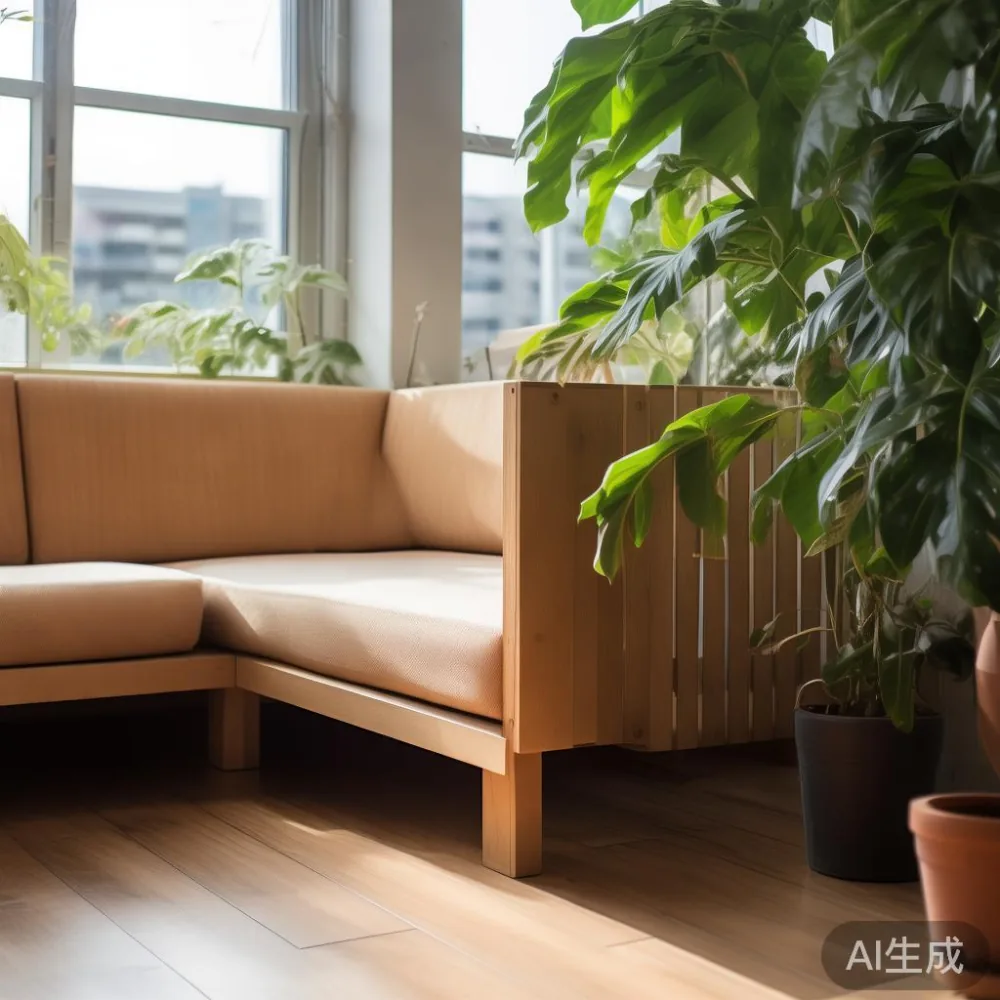
I went through this with my own furniture. Last month I visited a 4-room HDB in Bedok Reservoir where the owner had bought an imported engineered sofa seven years earlier. The frame was intact, but the surface ply along the backrest had bubbled and peeled about 12 cm along one seam, and the solid wood feet — advertised as "oak" by the brand — had darkened and warped roughly 4 mm out of plane. The owner told me the flat is air-conditioned only from 10 pm to 7 am, which is typical for households watching the SP Group bill. When the compressor cycles off, humidity spikes back into the 75–80% range within forty minutes. The sofa lives in that band for sixteen hours a day, seven days a week, 365 days a year. Multiply that out and it is easy to see why the piece looked ten years older than it was.
Cheap engineered cores and thin paper laminates take the worst of it. Solid timber, in contrast, is actually built to handle this kind of cycling — provided the species is right, the joinery is right, and the finish is right. That is where Foshan makers like MIDHILL, who have shipped solid wood pieces across more than fifteen countries from a hot, equally humid factory floor since 2008, tend to outperform imports designed for temperate living rooms in Frankfurt or Toronto. Below, I will walk through what humidity actually does to wood, why your hdb livingroom is a special case, and the specific things you can do — on any budget between SGD 60 and SGD 6,000 — to keep your wood looking the way it did on day one.
What Does 80% Relative Humidity Actually Do to a Solid Wood Sofa Frame?
Wood is hygroscopic. It absorbs and releases water vapour until it matches the surrounding air. At 80% RH, the moisture content of most furniture-grade hardwoods — ash, oak, walnut, rubberwood — climbs into the 14–18% range. Furniture built for indoor living is usually dried and acclimated to 6–10% MC, which is calibrated for climates closer to 45–55% RH. Every 1% change in moisture content drives about a 0.1–0.3% change in dimension across the grain. On a 220 cm long dining tabletop, a 4% swing translates to roughly 2.6 mm of lateral movement. That is enough to open a hairline crack at the breadboard end, rub two chair stretchers together, or cause a wardrobe door to swing closed on its own.
The risk is not constant shrinkage. It is the cycling. Singapore flats do not stay humid — they swing. The air-con pushes RH down to 55% overnight, then it climbs back to 80% by midday. Each round of swelling and shrinking adds micro-fatigue to glue lines, dovetail pins, mortise shoulders, and mitre joints. Over five years, a standard MDF-core piece can begin to delaminate. A well-built solid hardwood piece with traditional mortise-and-tenon or dowel joinery will instead shift with the air, leaving tiny seasonal gaps that close again when humidity rises.
This is also why the right nightstand, the right wardrobe, and the right bed frame behave so differently from each other in the same flat. A bedside table has small dimensions, so even a noticeable movement is hard to see. A 240 cm wardrobe has long, flat panels that cup, bow, or twist visibly if the inner frame is poorly designed. If you are choosing a wardrobe for an hdb livingroom wall, ask the seller what panel construction they use: floating frame with a torsion-resistant core, or just a glued-edge solid plank. Both can survive Singapore, but only the first will survive it silently.
Is MDF or Particleboard Really a Disaster in an HDB Living Room?
Not always — but the failure modes are sharper. MDF swells permanently when it gets wet, often by 5–10% in thickness, and it does not return to its original size when it dries. Particleboard is worse: a single spilled glass of water left overnight can puff an edge by 3 mm, and humidity alone will do the same over six to nine months. Laminated surfaces hide the swell until the edge band peels back, at which point the core looks like wet cake.
If your budget is tight — say SGD 60 for a small nightstand or an entry-level bedside stool — you can still buy these materials, but treat them as semi-disposable. Plan to replace them every four to six years. If you want something your children take to their own BTO in 2047, pay for solid hardwood furniture. A well-made rubberwood dining table in the SGD 1,200–1,800 bracket is a reasonable entry point. Solid ash and solid oak sit in the SGD 2,800–5,800 bracket. A MIDHILL sofa in solid ash with a removable, washable linen-blend cover typically lands between SGD 2,400 and SGD 4,800 depending on seat depth and configuration, and the frame carries a ten-year structural warranty. At that price point the per-year cost of ownership is already lower than a SGD 600 engineered sofa replaced every five years.
There is one more factor most buyers miss: shipping. Furniture imported from temperate factories arrives vacuum-sealed at very low moisture content — sometimes 4–6%. Within two weeks of opening the box, the timber recalibrates to 80% RH and moves visibly. Pieces assembled in a humid Foshan workshop, dried to a more realistic 8–10%, ship closer to equilibrium and settle less after they cross the South China Sea. The body of evidence for this is consistent across the trade. Foshan makers have known this for decades.
What Should I Look For in a Wood Finish That Can Handle 80% Humidity?
The finish is your last line of defence, and it matters more than species in some ways. A thick, multi-layer conversion varnish (sometimes called a catalyzed varnish) slows moisture exchange down to a crawl and is the standard for export-grade dining tables. Hardwax oil, popular on Scandinavian-style pieces, looks beautiful but allows the wood to breathe — which is great in Stockholm and harder work in Singapore. Open-pore matte finishes need a refresh every twelve to eighteen months in our climate. Closed-pore satin and gloss finishes can go five to seven years before a recoat.
Look for pieces that arrive with the finish on all six sides of every panel, including the underside of the table, the back of the headboard, and the inside of every drawer. A French provincial-style bed frame finished only on the visible faces will cup the hidden face within a year, and the visible face follows it.
If you are wondering how to style French provincial sofa in bedroom without inviting humidity damage, the answer is simpler than it sounds: keep the back of the sofa at least 8–10 cm away from the wall, leave the wardrobe side panels with 2–3 cm of breathing space against the side wall, and never push a solid wood dining table flush against a PVC-clad feature wall. Air needs to move behind and around the piece. The same principle applies if you are figuring out how to style French bed in apartment — small feet on castors or risers give the mattress base its own microclimate.
How Can I Keep My Wood Furniture Dry Without Running the Air-Con 24/7?
You do not need to freeze the family out. Three devices do most of the work for a typical 90 sqm HDB:
- A small dehumidifier (12 L/day class) in the hdb livingroom — about SGD 180 to SGD 280, pulls the RH band down to 55–60% when run for six to eight hours a day.
- Disposable silica gel or rechargeable calcium chloride canisters inside wardrobes and drawers — SGD 12 for a 12-pack, replaced every two to three months.
- A thermo-hygrometer with a digital readout — SGD 18 to SGD 35 — placed on the dining table or inside the wardrobe, so you can see humidity, not just guess.
Wipe spills within ten minutes, coast everything, and never drape a wet towel over a chair back. Move the sofa 8 cm out from the wall. Open wardrobe doors once a week for thirty minutes with a fan running across them so the trapped air turns over. That small habit alone reduces the musty smell that many owners complain about by the second monsoon season.
If you do this, the same solid wood dining table you bought for SGD 2,200 will still be the solid wood dining table you serve your daughter's wedding dinner on in 2040. If you skip it, you will be shopping for a replacement every five to seven years.
Which Wood Species Hold Up Best in a Singapore HDB Living Room?
From a purely dimensional-stability standpoint, ranked roughly from most stable to least stable in our climate:
- Rubberwood (Hevea) — low movement, plantation-grown, widely used in good Foshan factories. Holds paint and lacquer well.
- European beech — tight grain, takes finish nicely.
- White or red oak — open grain, stiffer, classic French light luxury look on a dining table or bed frame.
- Ash — close cousin to oak, slightly more flexible, common in Scandinavian-inspired pieces.
- American walnut — beautiful colour, moderately stable, drives the price up.
- Teak — the traditional local choice, but expensive and often cut from old stock.
- Cherry and maple — fine in air-conditioned rooms, more reactive in naturally ventilated spaces.
If you like the French light luxury / American light luxury / post-modern light luxury aesthetic in your hdb livingroom — think tapered legs on a lounge chair, slim brass pulls on a marble-topped side table, a low-profile bed frame with a pale-oak headboard — solid ash or solid oak will give you the look and the durability. Marble is also humidity-proof in the structural sense, but the wood plinth underneath still needs care.
One observation from trade buyers who have visited the top 10 French furniture maisons in Paris and Lyon: even Hermès-grade pieces are expected to live in 50% RH. Parisian apartments are dry, heated masonry buildings with stone floors. When those same designs land on the ninth floor of a Punggol BTO, they need a small adjustment in species or finish to behave. That adjustment is exactly what a Foshan workbench — where 80% RH is the daily default — is set up to do.
What Are the Real Costs of Owning Humidity-Resistant Solid Wood in Singapore?
Let me ground the numbers. Below is a realistic five-year ownership estimate for furnishing a 4-room HDB hdb livingroom, one master bedroom, and one dining area, all in solid wood:
- Solid wood sofa, 3-seater, ash frame with linen covers — SGD 3,200. Annual cost over 10 years: SGD 320.
- Solid wood dining table, 1.8 m, seats six, oak or ash — SGD 1,800. Annual cost: SGD 180.
- Four matching dining chairs — SGD 1,200 total. Annual cost: SGD 120.
- Solid wood bed frame, queen, ash headboard — SGD 1,600. Annual cost: SGD 160.
- Solid wood wardrobe, 240 cm sliding, ash or rubberwood — SGD 2,800. Annual cost: SGD 280.
- Two nightstands, ash — SGD 800 the pair. Annual cost: SGD 80.
- One marble-topped side table — SGD 1,400. Annual cost: SGD 140.
Add it up and you are at roughly SGD 12,800 of furniture, or about SGD 1,280 per year over a ten-year life. Compare that with rebuilding an MDF bedroom set every six years for SGD 4,500 and the math tilts heavily toward solid wood by year three. The total spend on consumables — dehumidifier bags, paste wax, microfibre cloths — runs about SGD 90 a year.
One important cost line that is easy to miss: delivery. HDB corridor widths run 1.2 m at the narrowest, lift openings are typically 0.9 m wide by 2.1 m tall, and stair turns are tight. A fully assembled 240 cm wardrobe is not making that trip. Make sure the seller ships it flat-pack with a documented re-assembly service, or a workshop in Singapore that can do it on-site. MIDHILL currently ships flat-packed from Foshan to Singapore addresses with free shipping above US$350 (roughly SGD 475), and a 14-day return window after delivery. Eleven to fourteen working days from order to door is typical for in-stock configurations. Lifetime refinishing — sanding, re-staining, re-sealing — is included on frames for registered owners, which is the kind of long-tail service that pays for itself by the second refinish.
What About Styling — Do Light-Luxury Pieces Need Special Care in a Humid Flat?
The styling side is shorter than most homeowners expect. If you already know how to style European wardrobe in bedroom and how to style French sofa in bedroom, most of the humidity logic is built in: floating walls, breathing room around pieces, soft natural light, one or two planters for humidity-loving species like pothos and calathea which actually pull moisture out of the air as a side benefit. The aesthetic and the maintenance line up.
When you compare a light luxury sofa vs Italian light luxury sofa for our climate, both can be the right answer — but the deciding factor is rarely the brand. It is whether the inner frame is solid wood, whether the joinery is mechanical, and whether the finish is closed. Italian light luxury often wins on leather quality and tufting detail. French and Chinese light luxury often wins on the wood component, because the factories have had to solve humidity for their own climate. A piece from a Foshan maker who also exports to temperate countries usually lands somewhere in the middle.
If you are still deciding between a light luxury sofa vs Italian light luxury sofa for your hdb livingroom, my rule of thumb after ten years of looking at this is simple: ask where the frame was built and what moisture content the wood was dried to. The answer tells you almost everything you need to know about how the next decade of your living room is going to feel.